







0 commentaires
Branched-chain amino acids (BCAAs) have become indispensable in the world of sports supplements. Composed of leucine, isoleucine, and valine, these essential amino acids cannot be synthesized by the body and must therefore be obtained through diet or supplementation. Their role in muscle metabolism and improving athletic performance is widely studied and appreciated by many athletes.
Understanding BCAAs
BCAAs account for approximately 35% of the essential amino acids present in human muscles and 14% of the total muscle amino acids. Leucine is particularly important because it activates the mTOR pathway, a key regulator of muscle protein synthesis. This activation promotes muscle growth and repair, which are crucial processes for athletes.
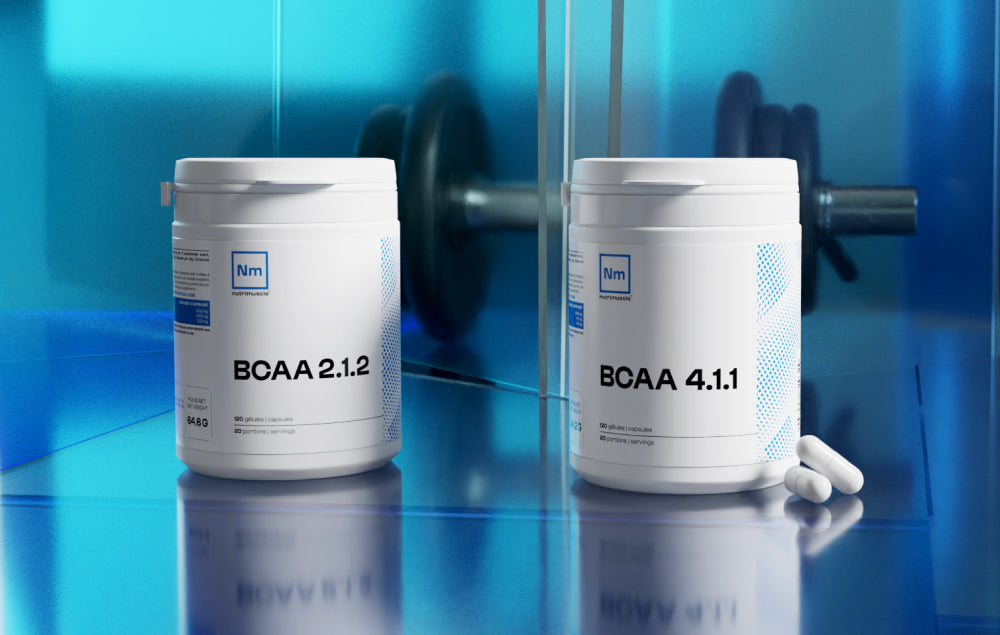
Ratios 2:1:1 and 4:1:1 refer to the proportion of these three amino acids in supplement formulations.
The 2:1:1 ratio indicates a composition of 2 parts leucine to 1 part isoleucine and 1 part valine. This formulation is considered the closest to the proportion naturally present in human muscles. It offers an optimal balance between the three amino acids.
The 4:1:1 ratio, on the other hand, contains 4 parts leucine to 1 part isoleucine and 1 part valine. This formulation emphasizes leucine, recognized as the most important amino acid for stimulating muscle protein synthesis. By increasing the proportion of leucine, this ratio aims to maximize anabolic effects and accelerate muscle recovery.
Benefits of BCAAs for Athletes
Improved Protein Synthesis
of muscle proteins, especially after intense physical exercise. One study found that BCAA consumption after resistance training significantly increased protein synthesis compared to a placebo.
Reduced Fatigue and Improved Endurance
BCAAs can help reduce central fatigue, a phenomenon where the brain perceives increased fatigue during exercise. One study showed that athletes who took BCAAs before exercise felt less fatigued and could train longer than those who took a placebo.
Reduced Muscle Soreness
Muscle soreness after exercise, known as DOMS (Delayed Onset Muscle Soreness), can be reduced with BCAA supplementation. One study demonstrated that participants who took BCAAs before and after intense exercise experienced less muscle soreness and recovered faster.
Preservation of Muscle Mass During Caloric Restriction
During a hypocaloric diet, muscle mass loss is a major concern. BCAAs can help preserve muscle mass by promoting a positive protein balance. One study showed that calorically restricted athletes who took BCAAs retained more muscle mass than those who did not.
Specific Cases Where BCAAs Are Beneficial
Vegan Athletes
Vegan athletes can benefit from BCAAs because their food sources are often less rich in these amino acids. Supplementation can compensate for this deficiency and support performance and recovery.
Endurance Sports
For endurance sports, such as marathons or long-distance cycling, BCAAs can be particularly beneficial. They provide an alternative energy source when glycogen stores are depleted, thus delaying fatigue.
Intense and Frequent Training
Athletes who train frequently and intensely can benefit from BCAAs to accelerate recovery and maintain their performance at a high level. One study showed that athletes who took BCAAs recovered faster between training sessions.
BCAAs represent a valuable dietary supplement for athletes, especially in specific contexts such as veganism, endurance sports, and hypocaloric diets. While scientific evidence continues to develop, the potential benefits of BCAAs make them a judicious choice for optimizing performance and recovery. As always, it is advisable to consult a healthcare professional before starting any supplementation.
Scientific References
- Zanella, P. B., et al. (2022). Oral Branched-Chain Amino Acids Supplementation in Athletes. Nutrients, 14(19), 4027.
- Wolfe, R. R. (2017). Branched-chain amino acids and muscle protein synthesis in humans: Myth or reality? Journal of the International Society of Sports Nutrition, 14, 30.
- Jäger, R., et al. (2017). International Society of Sports Nutrition Position Stand: Protein and exercise. Journal of the International Society of Sports Nutrition, 14, 20.
- Sci-Sport. (2023). BCAA en supplément : Utile ou pas. Consulté le 21 juin 2023.
- Carvalho, L. M., et al. (2022). Effects of BCAA Supplementation on Muscle Mass Preservation during Caloric Restriction. Nutrients, 14(19), 4027.
- Bet, G., et al. (2022). BCAA Supplementation in Vegan Athletes. Journal of Sports Science & Medicine, 21, 123-130.
- Reis, I. G. M., et al. (2022). BCAA and Endurance Performance: A Review. Sports Medicine, 52, 987-995.
- Alves, J. V., et al. (2022). The Role of BCAA in Recovery and Performance in High-Intensity Training. Journal of Strength and Conditioning Research, 36(8), 2100-2108.
