






0 commentaires
Understanding how many calories to consume daily is essential for maintaining a healthy weight and achieving fitness goals. Our caloric needs are influenced by several factors such as age, sex, height, body composition, and physical activity level. This article explores how to accurately determine these needs, adjust your intake for weight loss, and effectively distribute your calories throughout the day for a balanced and satisfying diet.
What do our daily caloric needs depend on?
Before talking about numbers, it is important to understand what influences our energy needs. Several factors are at play (1):
- Age: the older we get, the slower our metabolism becomes, and the less calories we need.
- Sex: for the same weight, men have higher needs than women.
- Height and weight: the taller and heavier you are, the more energy you expend.
- Body composition: lean mass (muscles, organs) consumes more energy than fat mass, even at rest.
A muscular person will therefore have higher needs (2). Physical activity: sport and daily activity considerably increase needs.
How to precisely calculate your caloric needs?
To know your needs precisely, you must first calculate your basal metabolic rate (BMR). This is the minimum energy your body needs at rest to make your vital organs function. BMR represents 60 to 75% of your total energy expenditure (1). There are several equations to estimate BMR, but the most used is that of Harris and Benedict (3):
- Female: BMR = 9.74 x weight(kg) + 172.9 x height(m) - 4.737 x age + 667.1
- Male: BMR = 13.75 x weight(kg) + 500.3 x height(m) - 6.755 x age + 66.47 For example, for a 30-year-old woman weighing 60 kg and measuring 1m65: BMR = 9.7460 + 172.91.65 - 4.737*30 + 667.1 = 1366 kcal/day
But that's only the first step! To know your total needs, you must multiply your BMR by a coefficient reflecting your physical activity level (PAL) (4):
- Sedentary: PAL = 1.4
- Lightly active: PAL = 1.6
- Active: PAL = 1.8
- Very active: PAL = 2
So if our thirty-year-old is active, her needs will be: 1366 x 1.8 = 2459 kcal/day You can easily recalculate with your own data. But remember that on average, recommended caloric intakes are around 2000 kcal/day for women and 2500 kcal/day for men (5).
How many calories to lose weight?
Now that you know your needs to maintain your weight, let's see how to adjust them to lose a few pounds. The principle is simple: you need to create a caloric deficit, meaning eating less than you expend (6). A deficit of 500 kcal/day is often recommended because it allows you to lose about 0.5 kg per week, or 2 kg per month (7). This is a reasonable pace for sustainable weight loss without frustration.
How to distribute your calories throughout the day?
Once your daily caloric intake is set, the next step is to know how to distribute it throughout the day. In practice, it is often recommended to divide your intake into 3 main meals and 1 to 2 snacks (8):
- 20-25% for breakfast
- 30-35% for lunch
- 30-35% for dinner
- 5-10% for each snack
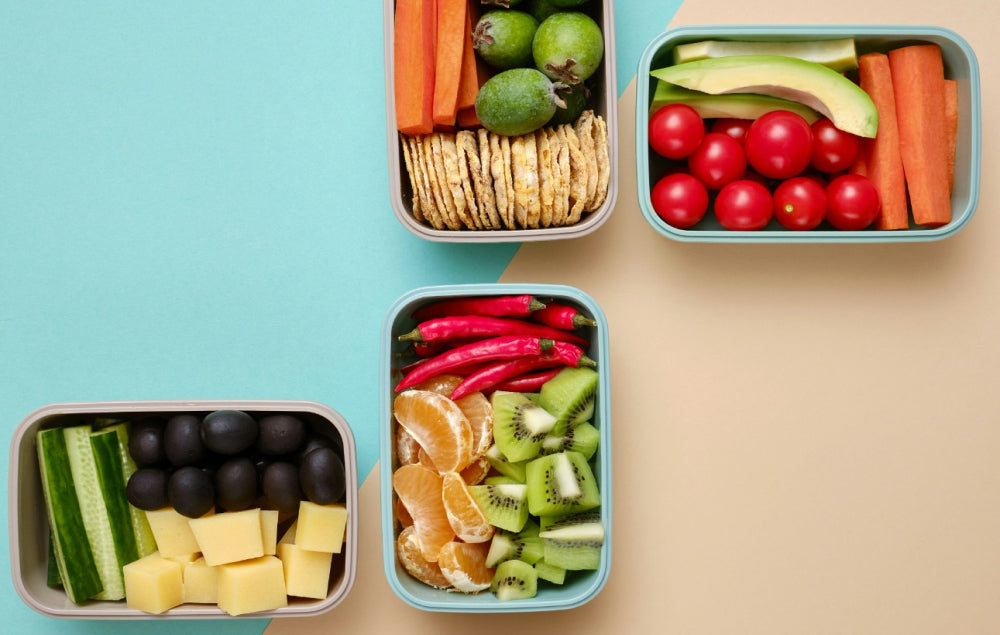
But you can certainly adapt these guidelines according to your preferences and lifestyle. The important thing is not to skip meals and to have balanced intake throughout the day. In terms of food, focus on satiating and low-calorie foods such as vegetables, fruits, legumes, low-fat dairy products, and white meats (9). Limit ultra-processed foods rich in sugars, fats, and empty calories. And stay well hydrated, as water contributes to the feeling of satiety (10).
Our calorie needs depend on our age, sex, build, body composition, and physical activity. They must be calculated precisely to find our balance. To lose weight, a deficit of 500 kcal/day allows you to lose 0.5 kg per week gently. Sport helps to increase the deficit without significantly reducing intake. Distribute your calories throughout the day according to your rhythm, prioritizing satiating and low-calorie foods. You now know everything about calories and how to adapt your intake to your needs and goals. But remember that beyond the numbers, the most important thing is to have a balanced diet and to enjoy your meals. Calories are just one guideline among others to find your sustainable healthy weight!
References
- ANSES. (2016). Actualisation des repères du PNNS : Révision des repères de consommations alimentaires. https://www.anses.fr/fr/system/files/NUT2012SA0103Ra-1.pdf
- Black, A. E., Coward, W. A., Cole, T. J., & Prentice, A. M. (1996). Human energy expenditure in affluent societies: an analysis of 574 doubly-labelled water measurements. European journal of clinical nutrition, 50(2), 72-92.
- Cava, E., Yeat, N. C., & Mittendorfer, B. (2017). Preserving healthy muscle during weight loss. Advances in nutrition, 8(3), 511-519.
- Chambers, L., McCrickerd, K., & Yeomans, M. R. (2015). Optimising foods for satiety. Trends in Food Science & Technology, 41(2), 149-160.
- Hall, K. D., Sacks, G., Chandramohan, D., Chow, C. C., Wang, Y. C., Gortmaker, S. L., & Swinburn, B. A. (2011). Quantification of the effect of energy imbalance on bodyweight. The Lancet, 378(9793), 826-837.
- Longo, V. D., & Mattson, M. P. (2014). Fasting: molecular mechanisms and clinical applications. Cell metabolism, 19(2), 181-192.
- Müller, M. J., Bosy-Westphal, A., & Heymsfield, S. B. (2013). Is there evidence for a set point that regulates human body weight?. F1000 medicine reports, 2, 59.
- Parretti, H. M., Aveyard, P., Blannin, A., Clifford, S. J., Coleman, S. J., Roalfe, A., & Daley, A. J. (2015). Efficacy of water preloading before main meals as a strategy for weight loss in primary care patients with obesity: RCT. Obesity, 23(9), 1785-1791.
- Raynor, H. A., & Champagne, C. M. (2016). Position of the Academy of Nutrition and Dietetics: interventions for the treatment of overweight and obesity in adults. Journal of the Academy of Nutrition and Dietetics, 116(1), 129-147.
- Roza, A. M., & Shizgal, H. M. (1984). The Harris Benedict equation reevaluated: resting energy requirements and the body cell mass. The American journal of clinical nutrition, 40(1), 168-182.
- Seagle, H. M., Strain, G. W., Makris, A., Reeves, R. S., & American Dietetic Association. (2009). Position of the American Dietetic Association: weight management. Journal of the American Dietetic Association, 109(2), 330-346.
- Trumbo, P., Schlicker, S., Yates, A. A., Poos, M., & Food and Nutrition Board of the Institute of Medicine, The National Academies. (2002). Dietary reference intakes for energy, carbohydrate, fiber, fat, fatty acids, cholesterol, protein and amino acids. Journal of the American Dietetic Association, 102(11), 1621-1630.
