





0 commentaires
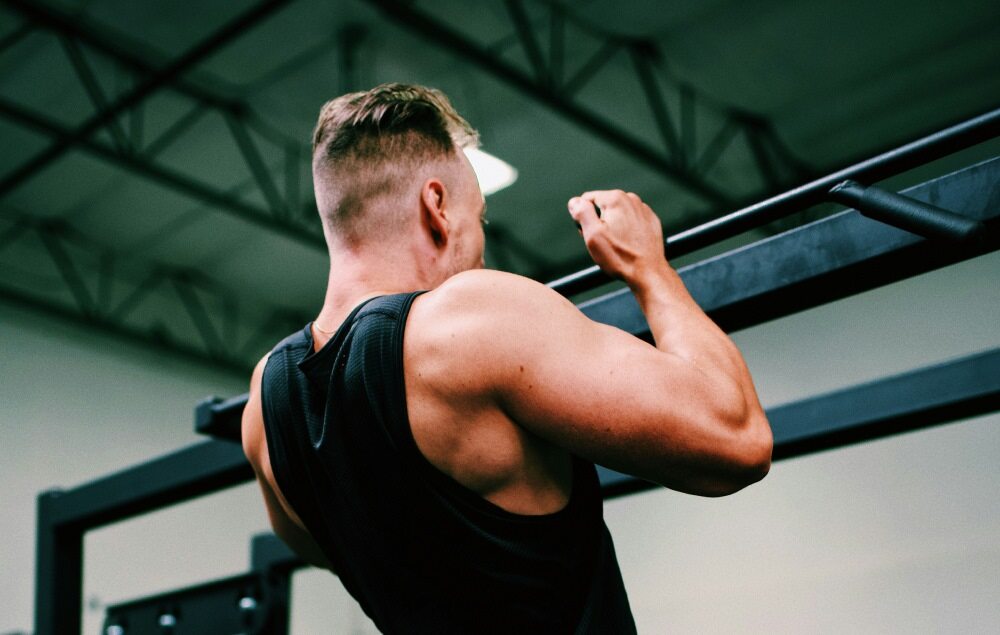
Pull-ups are a cornerstone of bodyweight exercises, ideal for developing a strong back and toned arms. Using a pull-up bar, they engage a wide range of stabilizer muscles and primary muscles, such as the latissimus dorsi and biceps. Whether you're a beginner or advanced, learn to master pull-ups and effectively integrate them into your training routine.
Which muscles are engaged with pull-ups?
Pull-ups engage many muscles, making them an excellent upper body exercise:
-
Main Muscles:
-
Latissimus Dorsi: The primary mover, it helps pull the body towards the bar.
-
Biceps Brachii: Strongly involved, especially during chin-ups (palms facing you).
-
Teres Minor: Stabilizes and assists in arm adduction.
-
Secondary Muscles:
-
Trapezius and Rhomboids: Keep the shoulder blades stable.
-
Forearms: Work to maintain grip on the bar.
-
Stabilizer Muscles: The abdominal belt is engaged to prevent swaying.
Who is it for?
Pull-ups adapt to different levels and body types:
-
-
Beginners: Those with little strength can use resistance bands or perform assisted pronated grip pull-ups on a machine.
-
People with long arms: These individuals will experience a greater range of motion, making the effort more demanding. A narrow grip can be a good alternative to reduce the range of motion.
-
Intermediates and Advanced: Vary the types of pull-ups (like pull-ups or chin-ups) to work different angles and muscles.
-
How to perform it?
Starting position
-
Hang from a pull-up bar, body well aligned, arms extended, with hand positions adapted to your goal:
-
Pronated grip (palms facing forward): Emphasis on the back.
-
Chin-up (palms facing you): Emphasis on the biceps.
-
Shoulder-width grip: The standard grip for good back activation.
-
Engage your abs to prevent swaying.
Execution of the movement
-
Pull with your arms by contracting your back muscles, bringing your chest towards the bar.
-
Stop when your chin clears the bar.
-
Control the descent (or negative phase) to strengthen the musculature.
-
Repeat the exercise.
How to integrate it into your training routine?
- Frequency: 2 to 3 times a week, in addition to other bodyweight exercises or upper body strength training exercises.
-
Progression:
- Beginners: 3 sets of 4 to 6 assisted repetitions or with an elastic band.
- Advanced: Increase repetitions or add weight to intensify the effort.
- Beginners: 3 sets of 4 to 6 assisted repetitions or with an elastic band.
- Variant with the negative phase: To progress quickly, focus on the descent by controlling the movement for 3 to 5 seconds.
Good or bad exercise?
Pull-ups are an essential bodyweight exercise for strengthening the back, arms, and shoulders:
-
Advantages:
-
Complete upper body workout.
-
Versatility thanks to the many types of pull-ups (pronated, pull-up, chin-up, etc.).
-
Accessible with a simple fixed bar or a pull-up bar.
-
Disadvantages:
-
Beginners may find the exercise difficult at first.
-
Poor technique (swinging, incorrect starting position) can reduce effectiveness or cause pain.
In conclusion, pull-ups are one of the best exercises for developing upper body strength and muscle mass. By adapting the shoulder width, the pronated grip, or the narrow grip, and mastering the execution of the movement, they will become a pillar of your training routine.
