






0 commentaires
Burpees, often described as the ultimate full-body exercise, combine strength, explosiveness, and endurance. Whether it's to burn calories, improve your cardio, or build functional muscles, burpees push you to give your best. Easy to incorporate into a circuit, they challenge your entire body in a few key movements.
What muscles do burpees work?
Burpees work the entire body by combining several dynamic movements:
-
Main muscles:
-
Pectorals and triceps: Engaged during the plank position phase and integrated push-ups.
-
Quadriceps, hamstrings, and glutes: Activated during the squat and jump.
-
Calves: Explosive in the vertical jump (jumping in the air).
-
Stabilizing muscles:
-
The abdominal core maintains stability during transitions between positions.
-
Shoulders and wrists support body weight during the squat thrust.
Who is it for? (Anatomical and general analysis)
Burpees are suitable for all levels, but their intensity requires adaptation depending on your physical condition:
-
Beginners: Start with simplified versions, without push-ups or jumps, to master the technique and reduce joint impact.
-
Advanced: Try variations like the royal H burpee, which includes even more explosive movements, to maximize effort.
-
Specific body types: People with shoulder or knee restrictions should opt for more controlled movements to avoid injuries.
How to perform a classic burpee?
Starting position
-
Start standing, feet hip-width apart, arms relaxed at your sides.
Movement execution
-
Squat down: Bend your legs and place your hands on the floor in front of you.
-
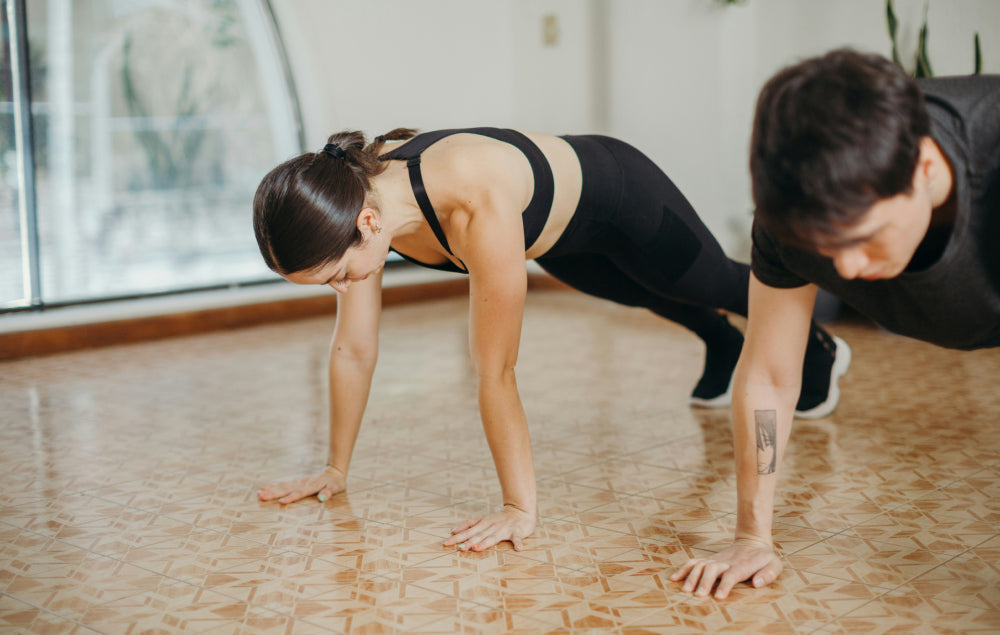
Plank position: Jump your feet back to assume a plank position, with arms extended.
-
Squat thrust: Immediately return by bringing your feet under you.
-
Jump up: Push off with your legs and finish the movement with a vertical jump, raising your arms above your head.
-
Repeat without pause to maintain intensity.
How to incorporate burpees into your workout?
-
Frequency: 1 to 3 times a week, depending on your goal.
-
Volume:
-
Beginners: 3 sets of 8 to 10 repetitions.
-
Advanced: 3 to 5 sets of 15 to 20 repetitions, or use a timer to perform a maximum of repetitions in 1 to 2 minutes.
-
Complementarity: Add burpees at the end of a session to boost your metabolism or integrate them into HIIT workout circuits to maximize cardio effort.
Good or bad exercise?
Burpees are an excellent exercise for working endurance, strength, and coordination, but they require rigorous execution:
-
Advantages:
-
Full-body exercise engaging many muscle groups.
-
Burns maximum calories in minimum time.
-
No machines or equipment needed.
-
Disadvantages:
-
The intensity can be challenging for beginners or people with joint problems.
-
Poor technique (sloppy jump, improperly positioned straight arms in a plank position) can lead to injuries.
Suggested alternative: the squat thrust
For a less intense version, perform only the transition between the squat and the plank, eliminating the jump and push-up. This is still effective for strengthening the core and legs.
