
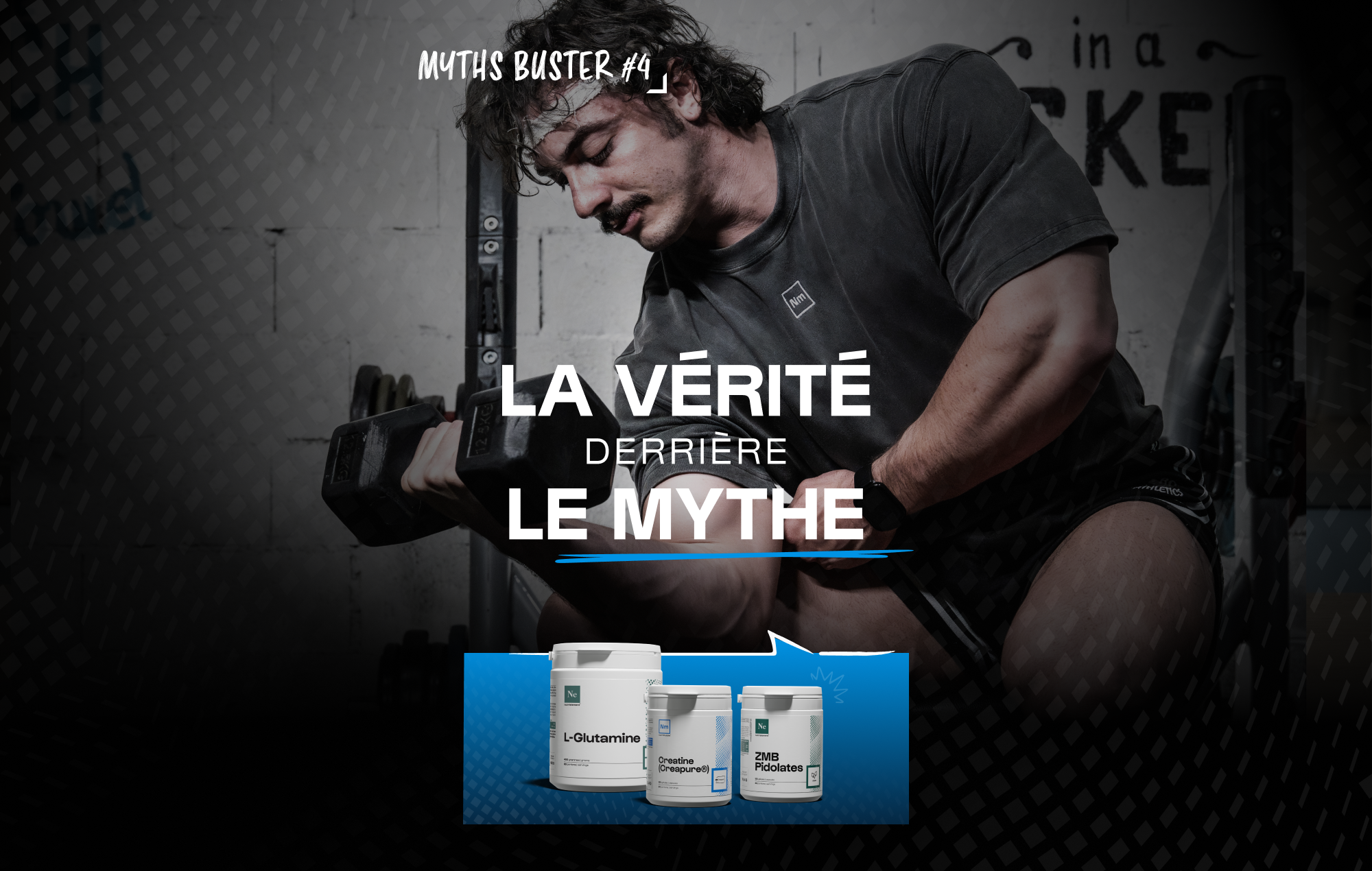
"If you're not sore after your workout, you haven't worked hard enough."
We've all heard this kind of phrase in locker rooms or on social media. For many, **soreness = successful workout**. But the reality is quite different.
Muscle soreness is not a reliable indicator of the quality or effectiveness of your session. It reflects a **normal physiological reaction of the muscle to an unaccustomed effort**, but does not necessarily reflect progression or muscle gain.
What is muscle soreness?
**Muscle soreness** (or DOMS for Delayed Onset Muscle Soreness) usually appears **12 to 48 hours after an intense effort**.
They are due to **micro-tears in muscle fibers** caused by an **unusual or more demanding workout than usual**, particularly during **eccentric phases** (when the muscle lengthens under tension, such as during a controlled squat descent).
This reaction triggers **local inflammation**: the body then sends nutrients, blood, and repair cells to the affected muscle.
It is this repair process that then strengthens the muscle fiber... but **the level of pain is not proportional to the effectiveness of this adaptation**.
Why does this myth persist?
Several reasons explain why the idea "the more I hurt, the more I've progressed" is so persistent:
- **Tangible proof**: feeling sore muscles gives the impression of having "worked hard".
- **The "no pain, no gain" culture**: popularized in the 80s-90s, this mentality entrenched the idea that pain was synonymous with progress.
- **First sessions**: when you start or change a program, soreness is often intense, which gives the illusion that it is necessary.
- **Lack of physiological explanations**: many confuse "soreness" and "muscle growth", while the two phenomena are **independent**.
In reality, **the absence of soreness does not mean that your session was ineffective**, but simply that your body has adapted to this type of effort.
What science says
Research is clear: **soreness is not a reliable indicator of workout quality.**
A study published in the Journal of Strength and Conditioning Research showed that the intensity of soreness correlates **neither with muscle hypertrophy** nor with strength progression.
Other studies indicate that **trained athletes experience less soreness**, while continuing to progress effectively.
Soreness depends more on:
- the **nature of the movement** (eccentric or concentric),
- the **unusual workload**,
- the **training level**,
- and even **individual factors** (genetics, inflammation, hydration).
In other words: **they provide information about the novelty of the effort, not its effectiveness**.
Soreness and muscle progression
**Muscle progression is primarily based on progressive overload**: gradually increasing volume, load, or execution quality.
This process stimulates muscle adaptation without necessarily causing noticeable pain.
Too much soreness, on the other hand, can become counterproductive:
- They **disrupt recovery** and limit training frequency.
- They can **alter technique** if you start again too soon without sufficient recovery.
- They sometimes indicate an **imbalance between effort and recovery** (lack of sleep, protein, or anti-inflammatory nutrients).
Systematically seeking soreness therefore amounts to **confusing suffering and performance**.
How to promote better recovery?
**Good recovery limits the intensity and duration of soreness**, while optimizing progression.
1. Take care of your diet
- **ZMB**: promotes muscle recovery and sleep while supporting hormonal synthesis.
- **Glutamine**: contributes to muscle recovery, supports cellular hydration, and the immune system.
- **Creatine**: improves strength and power during intense efforts and aids recovery between sets.
- **Sufficient protein intake**: proteins promote muscle repair.
- **Omega 3**: reduce inflammation and improve muscle recovery.
- **Hydration and electrolytes**: good fluid balance helps eliminate metabolic waste.
2. Get enough sleep
Sleep is the key phase for hormonal and muscle regeneration. Lack of sleep prolongs soreness and slows progression.
3. Activate recovery
- Light stretching, mobility, massage, or **foam rolling**.
- Gentle activities (walking, cycling, swimming) to stimulate blood circulation.
4. Adapt your training volume
If soreness becomes debilitating, **slightly reduce the load or volume** until your body adapts.
What to remember
Soreness is **not a sign of effectiveness**, but a simple signal that your body is discovering or rediscovering an effort. What really matters is:
- **training regularity**,
- **controlled progression of loads**,
- and **optimized recovery**.
Seeking pain does not make you stronger: **consistency, technique, and adapted nutrition do.**