





0 commentaires
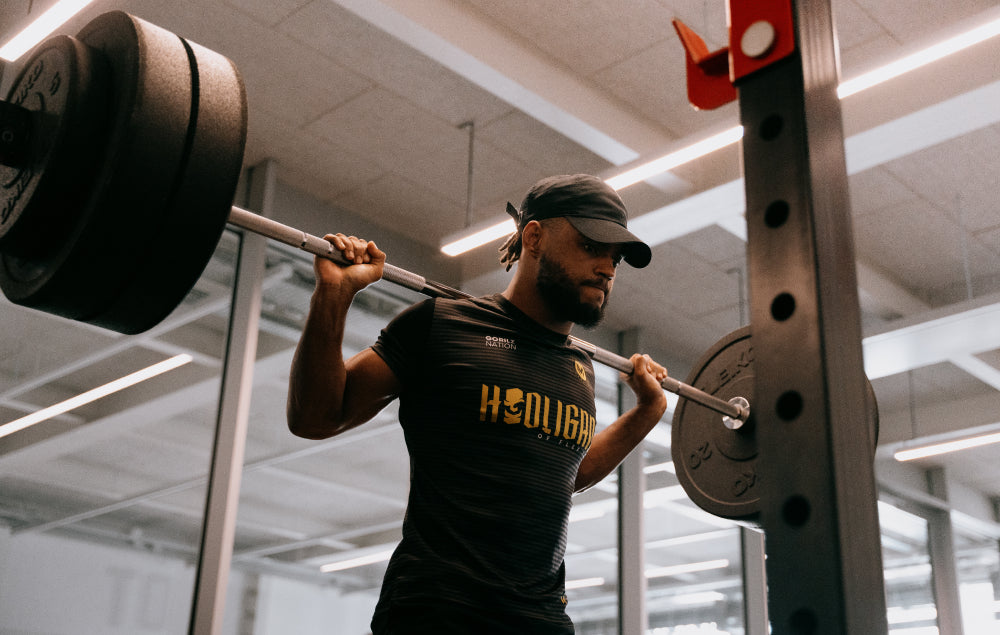
The squat is a movement renowned for developing strength and muscle mass in the legs and hips. A true pillar in the gym, this strength training movement primarily targets the thighs and glutes.
Let's explore the details of this strength training exercise and the key points for doing squats with impeccable technique.
Which muscles are used?
The main muscles engaged during a squat are:
-
Quadriceps: The muscles on the front of the thighs, essential for knee extension.
-
Hamstrings: Located at the back of the thigh, they participate in knee flexion and help stabilize the hip.
-
Glutes (gluteus maximus): Engaged during hip extension, particularly during the ascent phase.
-
Stabilizing muscles: The abs, lower back, and muscles of the lower back play a crucial role in maintaining balance and posture.
Who is it for?
The squat is suitable for a wide audience, from beginners to experienced practitioners. However, individual morphology can influence the ease of performing a squat:
-
Femur length
-
Long femurs: People with long femoral segments often find it harder to keep their torso upright. To reach a position where the thighs are parallel to the ground, they will need to lean their torso further forward, which can increase the strain on the lower back.
-
Short femurs: They can more easily reach the bottom of the movement, with a less-bent torso, which makes the execution easier for the quadriceps.
-
Torso size
-
Long torso: A long torso can help maintain an upright posture.
-
Short torso: Can lead to a different center of gravity, requiring a particular balance to be found (often by adjusting stance width or foot orientation).
-
Ankle and hip mobility
-
Good ankle flexion (dorsiflexion) is crucial for descending low enough without lifting the heels.
-
Limited hip mobility can restrict range of motion or cause compensations (knees caving in, rounded back).
-
Adaptation solutions
-
Elevated heels (small plates under the heels or squat shoes) to compensate for insufficient ankle mobility and maintain a more upright torso.
-
Squat variations (Front squat, Goblet squat, Sumo squat, etc.) to better respect body type and reduce stress on the back or knees.
In summary, everyone can do squats, but it is essential to adapt the technique and posture to one's body type and mobility to avoid injury and discomfort.
How to perform it?
Starting position
-
Foot placement: Place them shoulder-width apart or slightly wider. Point your toes outwards (15° to 30°) depending on your comfort.
-
Torso alignment: Keep your chest high, shoulders back, and back straight (slight natural arch is acceptable).
-
Gaze: Fix your gaze on a point in front of you to help maintain posture.
Execution of the movement
-
Descent:
-
Inhale and bend your knees and hips as if sitting in a chair.
-
Keep your back neutral and ensure your knees follow the direction of your toes.
-
Descend until your thighs are parallel to the ground, or even lower if your mobility allows, without rounding your lower back.
-
Ascent:
-
Push through your heels while exhaling and contract your quadriceps and glutes to return to the starting position.
-
Keep your abs engaged to stabilize your spine.
Technical tips
-
Breathing: Inhale deeply before the descent, then exhale during the ascent.
-
Controlled rhythm: Avoid jerky movements, especially at the bottom of the squat, to protect your joints.
-
Bracing: Maintain constant tension in your core and back to prevent hyperextension or excessive rounding.
How to incorporate it into your training routine?
-
Frequency: 1 to 2 times per week, varying intensities and ranges of motion.
-
Progression:
-
Max strength: Short sets (3-5 repetitions) with heavy loads.
-
Hypertrophy: Moderate sets (8-12 repetitions) to stimulate muscle growth.
-
Endurance: Long sets (15+ repetitions) with lighter loads.
-
Squat variations:
-
Front Squat: Barbell placed in front, emphasizing quadriceps and core bracing.
-
Sumo Squat: Feet wide apart, targeting the inner thighs and glutes more.
-
Goblet Squat: With a dumbbell held in front of the chest, ideal for beginners or for working on mobility.
Good or bad exercise?
The squat remains a reference strength training exercise for developing lower body strength and muscle mass. When performed correctly, it strengthens the hamstrings, quadriceps, glutes, and generally improves physical condition.
However, there are points of attention to be aware of:
-
Incorrect execution: An overly rounded back, knees caving inwards, or an inappropriate range of motion can lead to pain, particularly in the lower back and knees.
-
Morphological adaptation: Depending on the length of your segments and your mobility, it is recommended to adjust the stance (foot width and orientation) or use accessories (elevated heels, weightlifting belt, etc.).
-
Verdict: Taking into account your morphology and technique, the squat is one of the best exercises for lower body development. The important thing is to perform it correctly, paying attention to your posture and adapting the range of motion to progress safely.
In conclusion, the squat is a fundamental movement for anyone looking to do squats and gain strength, mass, and stability.
Respect the starting position, ensure your thighs are parallel to the ground on the descent (or lower if you can), and adapt the technique to your body type to reap the maximum benefits without risk of injury.
