








0 commentaires
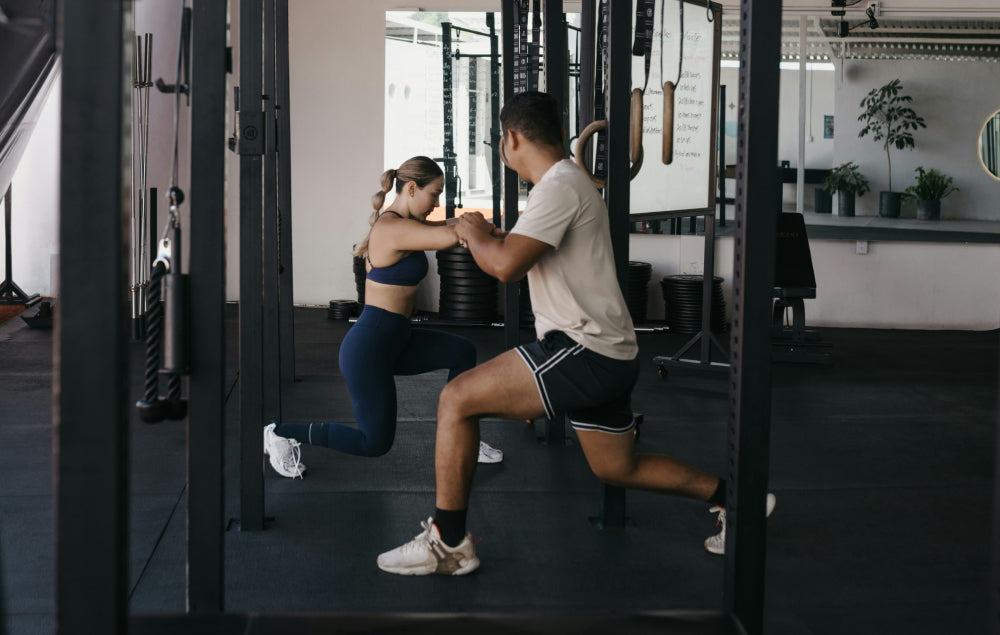
Forward lunges are among the essential exercises for strengthening the lower body and improving stability. Thanks to their unilateral nature, they engage the quadriceps, glutes, and hamstrings, while also developing balance.
Whether it's for gaining strength, toning your legs, or completing a full workout, forward lunges are a must-do.
What muscles do forward lunges work?
Forward lunges target several muscle groups, making them an excellent exercise for toning and strengthening the lower body:
-
The quadriceps: Primary muscles engaged for pushing and stabilizing during the descent and ascent.
-
The glutes and hamstrings: They work during hip extension, especially in the pushing phase.
-
The calves: Stabilize the ankle during the movement.
-
The core muscles: Keep the body aligned and straight.
Who is it for? (Anatomical and general analysis)
Forward lunges are suitable for most practitioners, but certain morphological points influence their effectiveness:
-
Ectomorphic morphology (long legs): These practitioners may struggle to maintain a 90-degree angle at the knees, especially if the back leg is too extended. Good coordination is necessary to avoid overloading the quadriceps.
-
Beginners: Using body weight without additional load is ideal for learning the movement. Reverse lunges or walking lunges can be more comfortable and reduce pressure on the front knee.
-
Advanced practitioners: Weights (dumbbells, barbell) increase intensity and promote muscle hypertrophy.
How to perform forward lunges?
Starting position
Start standing, feet shoulder-width apart, arms relaxed at your sides, or holding dumbbells to increase the load.
Performing lunges
-
Take a large step forward with one leg, keeping your back straight and your gaze forward.
-
Lower until both knees form a 90-degree angle, with the front thigh parallel to the floor and the back knee close to the floor without touching it.
-
Push off with the front leg to return to the starting position.
-
Alternate with the other leg to balance the work.
How to incorporate lunges into a workout program?
Forward lunges can be integrated into various workout programs to develop strength, balance, or endurance:
-
Frequency and volume: Practice 2 to 3 times a week, adapting the number of repetitions:
-
10 to 12 repetitions per leg for strength.
-
15 to 20 repetitions for endurance.
-
Progression: Add progressive loads (dumbbells or kettlebells), or increase difficulty with variations like walking lunges.
Good or bad exercise?
Forward lunges are an excellent lunge exercise for strengthening the muscles worked, improving balance, and developing coordination. However, certain points should be considered:
-
Advantages:
-
Functional movements, useful for sports or daily activities.
-
High engagement of the glutes and hamstrings, promoting harmonious lower body development.
-
Works stabilizers, essential for injury prevention.
-
Disadvantages:
-
For practitioners with knee pain, the descent can be uncomfortable. In this case, prioritize variations like reverse lunges, which reduce pressure on the front joint.
An alternative: step-ups
To replace forward lunges, try step-ups, which involve stepping onto a bench or box with one leg, followed by the other. This exercise is just as effective for the glutes and hamstrings, while limiting impact on the knees.
